International cooperation · Education
Counting the people who are missing
The opening lecture of ICORD's rare-disease school argued that rare diseases are a public-health problem before they are a clinical one — and that without a denominator there is no plan.
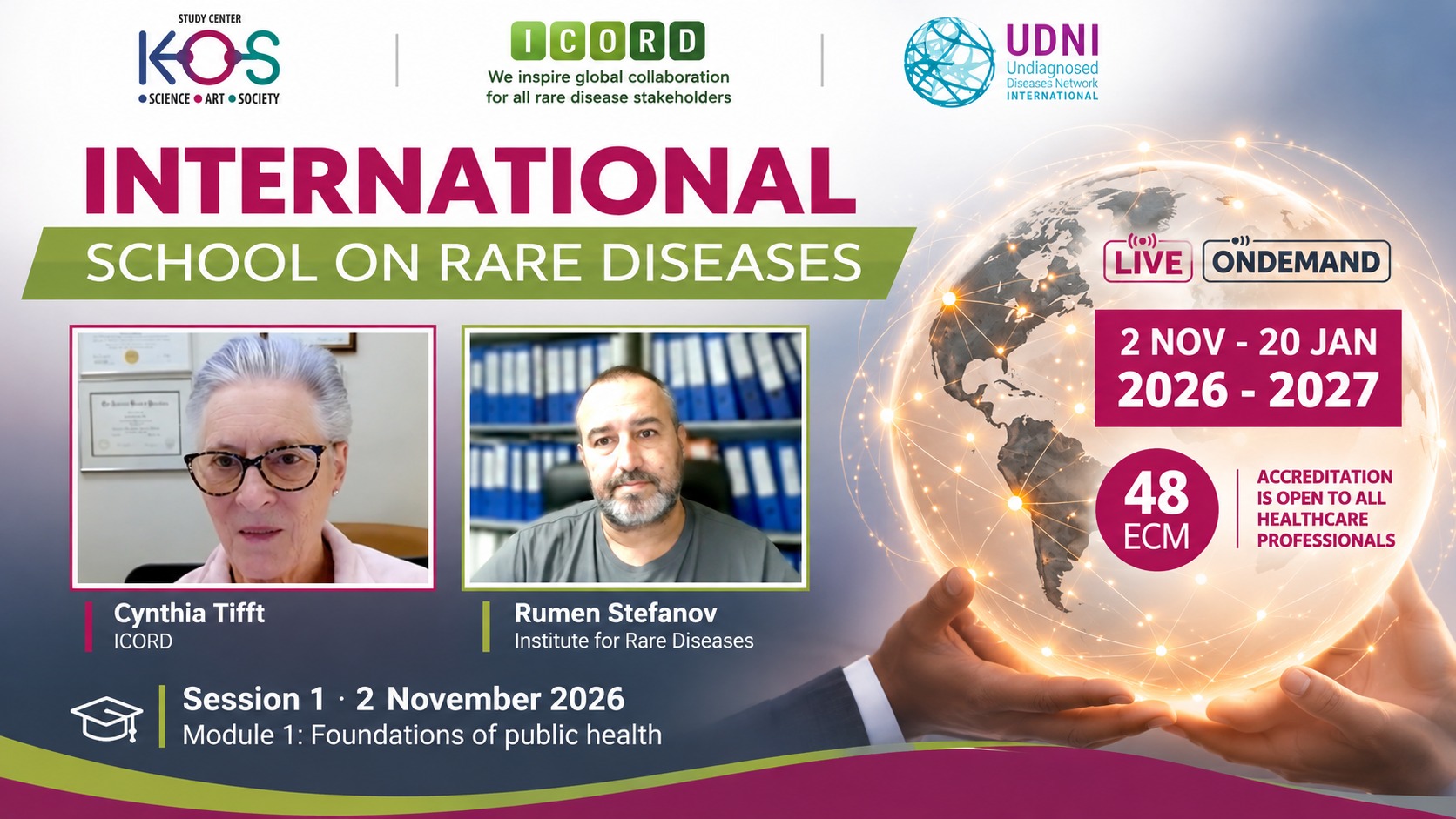
A clinician may know a handful of patients very well while the system does not know how many such patients exist, where they are, or what happens to the undiagnosed. That sentence, from the opening lecture of ICORD's International School on Rare Diseases, is the shortest argument for treating rare diseases as a public-health problem rather than only a clinical one.
Three levels, not one
Public health, Stefanov argued, is the organised effort of society to prevent disease, prolong life and promote health in a defined population. It is not the healthcare system, and population health is not the sum of clinical findings. The distinction matters for rare diseases because the clinical view and the population view fail in different ways: a doctor can be excellent with the patient in front of them and still have no idea how many people with the same condition never reach a clinic.
“The population orientation means accounting for everyone in the denominator. For rare diseases this means counting the undiagnosed and the dispersed.”
Prof. Rumen Stefanov, Medical University of Plovdiv; Institute for Rare Diseases, Bulgaria
He set out the standard instruments — the 1988 Institute of Medicine triad of assessment, policy development and assurance, and the WHO list of twelve essential public health functions published in 2023–2024 — and noted that they apply to rare diseases in full, only under harder conditions: small numbers, scarce expertise, dispersed data, incomplete ascertainment.
Geoffrey Rose's two questions from 1985 — why this individual, and why this population — were used to show where the analogy breaks. Most rare diseases are genetic, so the classic population strategy does not transfer directly. Newborn screening, in this framing, is the one genuine population strategy rare diseases have.
Who opened the course
Domenica Taruscio, MD
Member of the ICORD board; former director of the National Centre for Rare Diseases, Istituto Superiore di Sanità (Italy)
School director — opened the course and Module 1

Cynthia Tifft, MD, PhD
President of ICORD; senior clinician and deputy clinical director, National Human Genome Research Institute (NIH); director of the Pediatric Undiagnosed Diseases Program
School director
Who spoke

Prof. Rumen Stefanov, MD, PhD
Past-President of ICORD; Medical University of Plovdiv; Institute for Rare Diseases, Bulgaria
Public Health and Population Health: Definitions, Core Functions and Historical Evolution

Prof. Manuel Posada de la Paz
Director, Institute of Rare Diseases Research (IIER), Instituto de Salud Carlos III, Spain
Population Health Needs and Inequalities: From Determinants and Disease Burden to Policy Priorities
Eva Bermejo Sánchez, PhD
IIER, Instituto de Salud Carlos III; Spanish Collaborative Study of Congenital Malformations (ECEMC)
Prevention and Public Health Interventions in Rare Diseases: The Example of Congenital Malformations
Module 1 is co-led by Rumen Stefanov and Manuel Posada.
The arithmetic behind the argument
The lecture put the scale plainly: between 3.5% and 5.9% of the world's population lives with a rare disease — 263 to 446 million people at any one time, according to the Orphanet-based analysis by Nguengang Wakap and colleagues (2020). In a country of seven million, that implies roughly 250,000 to 400,000 patients.
For comparison, the European Union's definition of rarity is no more than 5 cases per 10,000 — fewer than 1 in 2,000. The threshold is a policy instrument, not a biological fact, and it shapes who is counted.
“Individually rare, collectively common; structurally difficult; a question of equity.”
Prof. Rumen Stefanov, Medical University of Plovdiv; Institute for Rare Diseases, Bulgaria
Equity, he argued, is the third argument alongside arithmetic and structure — a health system built around common conditions systematically disadvantages patients with rare ones.
The agenda is set; implementation is not
The lecture traced how rare diseases moved from a market-failure problem to a governance problem:
The lecturer's conclusion was that the agenda-setting phase is over. What remains is implementation in national systems — which is where the instruments named in the lecture become practical: registries, disease coding, surveillance, and the uncomfortable discipline of counting people who are not yet in any database.
What this means for Russia
The following is Genome-Inform's analysis; the lecture contains no reference to Russia.
Russia has no adopted national rare-disease plan, and ORPHAcodes are not used systematically — rare diseases remain folded into broader diagnostic groups, which makes cross-country comparison and precise planning difficult. There is no nationally representative prevalence estimate; public discussion tends to rely on extrapolating international shares. Applying the 3.5–5.9% range to a population of about 146 million gives roughly 5.1 to 8.6 million people — our calculation, not a measured figure.
What exists is a set of separate mechanisms: disease-specific registries, the Circle of Kindness foundation for children with severe and rare conditions, and regional financing for adults under Government Decree No. 403. Each works within its own perimeter. None of them, on its own, answers the question the lecture kept returning to: who is missing from the denominator.
Caveats
The lecture transcript used for this analysis is machine-generated, and figures are attributed either to the lecture or to the publications listed below — not presented as Genome-Inform's own findings. The Russian prevalence range is an extrapolation and is labelled as such.
Sources
Nguengang Wakap S., Lambert D.M., Olry A. et al. Estimating cumulative point prevalence of rare diseases: analysis of the Orphanet database. European Journal of Human Genetics. 2020;28(2):165–173. doi:10.1038/s41431-019-0508-0
Regulation (EC) No 141/2000 on orphan medicinal products.
UN General Assembly. Resolution A/RES/76/132, 16 December 2021.
World Health Assembly. Resolution WHA78.11, 24 May 2025.
Institute of Medicine. The Future of Public Health. Washington, DC: National Academy Press, 1988.
WHO. Application of the Essential Public Health Functions. Geneva, 2024.
ICORD International School on Rare Diseases, programme and session materials, 2 November 2026.
Disclosure: Genome-Inform's editor-in-chief is a participant in the ICORD educational programme. This article is based on the lecture and its published materials. Sources checked 4 November 2026.
